In the relentless pursuit of productivity, we have become obsessed with doing more. Our calendars are meticulously color-coded, our task management apps are synced across every device, and we relentlessly chase the elusive state of “Inbox Zero.” We operate under the grand delusion that productivity is a function of volume—that the more tasks we check off, the more successful and fulfilled we will become. Yet, this constant doing often leads not to accomplishment, but to burnout, stress, and a lingering feeling of busyness without true progress. The fundamental flaw in this approach is that it focuses on efficiency (doing things right) at the expense of effectiveness (doing the right things).
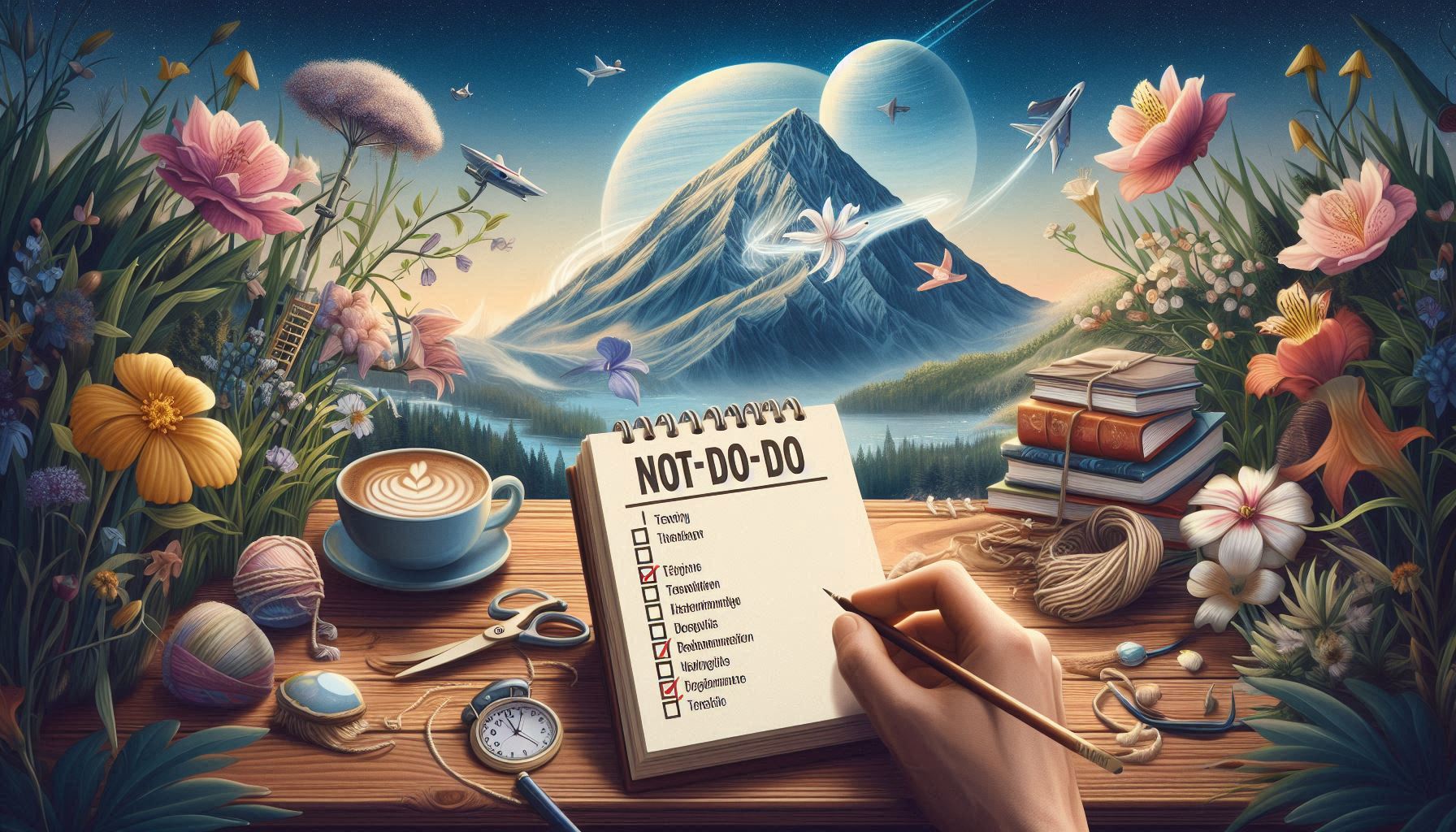
The true path to profound productivity and a meaningful life is not found in an ever-expanding “To-Do” list, but in its ruthless and strategic counterpart: the “Not-To-Do” List. This is not merely a list of tasks to avoid; it is a philosophical framework and the ultimate filter for prioritization. It forces a paradigm shift from “What can I do?” to “What must I do, and, more importantly, what must I not do to protect it?” This guide will explore the psychological underpinnings of the “Not-To-Do” list, provide a detailed framework for creating your own across life and work, and demonstrate how this simple tool can become your most powerful asset for focus, clarity, and impact.
The Psychology of Negation: Why Saying “No” is So Powerful
Our brains are wired for acquisition and action. From an evolutionary standpoint, this was advantageous: gather more resources, explore new territories, seize opportunities. In the modern knowledge economy, however, this instinct works against us. We are inundated with potential actions—emails, notifications, “quick questions,” and new projects—all vying for our limited cognitive resources.
Every time we say “yes” to a low-value task, we are not just allocating time to it; we are incurring significant cognitive costs.
- Decision Fatigue: Every task on your to-do list, no matter how small, represents a decision you haven’t made yet. A bloated list silently drains your mental energy from the moment you wake up, as your subconscious mind is already weighing the burden of unfinished business (Baumeister & Tierney, 2011). A “Not-To-Do” list pre-makes these decisions for you, conserving precious willpower for the decisions that truly matter.
- The Zeigarnik Effect: Psychologist Bluma Zeigarnik discovered that uncompleted tasks tend to occupy our minds more than completed ones. They create mental “open loops” that cause anxiety and intrusive thoughts, preventing deep focus on the task at hand. A “Not-To-Do” list acts as a conscious closure mechanism. By formally writing down and committing to not doing something, you give your brain permission to let it go, effectively closing the loop and freeing up mental RAM.
- Opportunity Cost, Realized: Economics teaches us that the cost of any choice is the value of the next best alternative forgone. An hour spent scrolling through social media is not free; it costs you an hour you could have spent learning a new skill, exercising, or connecting with a loved one. The “Not-To-Do” list makes these hidden opportunity costs starkly visible. It is a constant reminder that when you choose to engage in a low-value activity, you are actively choosing not to engage in a high-value one.
Beyond Time Management: The “Not-To-Do” List as an Identity Filter
Traditional productivity tools operate at the level of action. The “Not-To-Do” list operates at the more profound levels of values and identity. It is a statement of who you are and who you are not.
Creating this list forces you to ask foundational questions:
- What are my core values and long-term goals?
- What behaviors are inconsistent with the person I want to become?
- What habits drain my energy and dilute my focus?
By defining what you will not stand for and what you will not do, you draw a boundary around your future self. It’s a proactive declaration that protects your attention, your time, and your integrity from the myriad forces vying for them. As author Greg McKeown argues in Essentialism, this is the disciplined pursuit of less. It’s about making a one-time decision to eliminate an entire category of distraction, rather than having to decide on a case-by-case basis, which is far more mentally taxing.
Crafting Your Ultimate “Not-To-Do” List: A Practical Framework
Your “Not-To-Do” list should be dynamic and personal, but it can be constructed by examining key areas of life and work. Here are categories and examples to inspire your own.
Category 1: Mental and Emotional Habits (The Internal Saboteurs)
These are the patterns of thinking and reacting that hijack your focus and emotional well-being.
- I will not multitask. I will practice single-tasking, giving my full attention to one important activity until completion.
- I will not check my email or messages first thing in the morning. I will protect the first hour of my day for my most important work.
- I will not ruminate on past mistakes or anxiously catastrophize about the future. I will acknowledge the thought and gently return to the present moment.
- I will not seek perfection in tasks where “good enough” achieves the desired outcome (the 80/20 Principle).
- I will not compare my behind-the-scenes to everyone else’s highlight reel on social media.
Category 2: Time and Attention Management (The External Drainers)
These are the activities and distractions that fragment your time and prevent deep work.
- I will not attend meetings without a clear agenda and a defined desired outcome.
- I will not leave notifications enabled on my phone or computer during focused work sessions.
- I will not say “yes” immediately to requests. I will use the phrase, “Let me check my calendar and get back to you,” to create space for a deliberate decision.
- I will not mindlessly scroll through social media or news feeds without a specific purpose and time limit.
- I will not start my day without a pre-defined MIT (Most Important Task).
Category 3: Work and Productivity Pitfalls (The “Busywork” Traps)
These are the professional habits that create the illusion of productivity without generating real results.
- I will not strive for “Inbox Zero” as a measure of productivity. I will batch-process emails at designated times to protect creative focus.
- I will not take on low-impact projects that do not align with my core responsibilities or goals.
- I will not confuse motion with action. (e.g., endless planning, organizing tools, and researching without executing).
- I will not work through lunch or consistently late into the night. I recognize that sustainable performance requires rest and recovery.
- I will not fail to delegate or automate tasks that are not the best use of my unique skills and time.
Category 4: Communication and Relationships (The Energy Vampires)
These items help you manage your social and professional interactions to preserve energy and build stronger connections.
- I will not engage in gossip or negative complaining sessions that serve no constructive purpose.
- I will not people-please at the expense of my own priorities and well-being.
- I will not have conversations without listening actively (instead of just waiting for my turn to talk).
- I will not tolerate consistent disrespect or unprofessionalism in my work or personal relationships.
The Implementation Strategy: Making Your List Active
A list is useless without action. Here’s how to integrate your “Not-To-Do” list into your life.
- The Quarterly Review: Don’t try to build the perfect list in one day. Start with 3-5 items. Every quarter, sit down and review your list. What habits have you successfully eliminated? What new distractions have emerged that need to be added? This makes the practice a living, evolving part of your growth.
- Environmental Design: Your willpower is finite. Instead of relying on it, design your environment to make the “not-doing” automatic.
- To not check your phone first thing: Charge it in another room.
- To not get distracted by notifications: Turn them all off and use app blockers during work hours.
- To not say yes to every request: Have a prepared, polite template for declining.
- The Pre-Mortem: Before starting your day or a new project, briefly consult your “Not-To-Do” list. Anticipate where these pitfalls might appear and plan your defense. For example, “I have a lot of writing to do today, so I will not open my email until noon to avoid context-switching.”
- Reframe “No”: Saying “no” is not negative; it is a positive affirmation of your priorities. As investor Warren Buffett famously said, “The difference between successful people and really successful people is that really successful people say no to almost everything.” Practice saying, “No, because I am committed to [X Priority].” This connects the refusal to a higher purpose.
The Liberating Outcome: From Scarcity to Abundance
Adopting the “Not-To-Do” list mindset creates a profound shift from a scarcity mindset (I have to do it all) to an abundance mindset (I get to choose what matters most). The energy you once spent on low-value tasks, anxiety, and distraction is redirected. You create space—space for deep work, for strategic thinking, for creativity, and for rest.
This space is not empty; it is fertile ground. It is where breakthrough ideas are born, where true mastery is developed, and where a life of purpose is built, one intentional “no” at a time. You stop being a reactor to external demands and start being the architect of your own time and energy.
The ultimate prioritization filter isn’t about ranking your “To-Do’s”; it’s about having the courage and clarity to eliminate the vast majority of them before they ever reach your list. It is the practice of subtraction for a multiplicative effect on your impact and your peace of mind. Start your “Not-To-Do” list today. It may be the most important thing you never do.
Conclusion
The relentless pursuit of productivity through endless doing is a Sisyphean task, a race with no finish line that leads only to exhaustion. The “Not-To-Do” list offers a profound escape from this cycle. It is far more than a simple list; it is a philosophical stance, a commitment to living and working by design, not by default. By consciously defining and upholding the boundaries of what we will not allow into our lives, we perform the ultimate act of prioritization. We move from being reactors to external demands to architects of our own time, energy, and focus.
This practice of strategic subtraction is not about deprivation; it is about liberation. The mental space reclaimed from anxiety, distraction, and low-value busyness becomes fertile ground for what truly matters: deep work that moves the needle, creative breakthroughs, strategic insight, and meaningful rest. It allows us to invest our finite resources—our attention, our hours, our passion—into the few things that generate immense value and align with our core identity.
Ultimately, the “Not-To-Do” list empowers us to redefine success not as the volume of tasks completed, but as the significance of the impact we make. It is the disciplined pursuit of less, but better. By having the courage to say “no” to the non-essential, we finally create the capacity to give a resounding, focused, and powerful “yes” to a life of purpose, impact, and fulfillment. Start building your list not as an exercise in negation, but as the most affirmative step you can take toward the life you intend to live.
SOURCES
Baumeister, R. F., & Tierney, J. (2011). Willpower: Rediscovering the greatest human strength. Penguin Press.
McKeown, G. (2014). Essentialism: The disciplined pursuit of less. Crown Business.
Newport, C. (2016). Deep work: Rules for focused success in a distracted world. Grand Central Publishing.
Zerwas, F. K., & Ford, B. Q. (2021). The meaning of guilt: Reconciling the past to inform the future. Current Directions in Psychological Science, 30(5), 427–434. (Note: This reference connects to the broader research on rumination and moving past mistakes, relating to the Zeigarnik Effect. The original Zeigarnik work is from 1927 but is often cited in modern contexts like this).
HISTORY
Current Version
Sep 3, 2025
Written By:
SUMMIYAH MAHMOOD