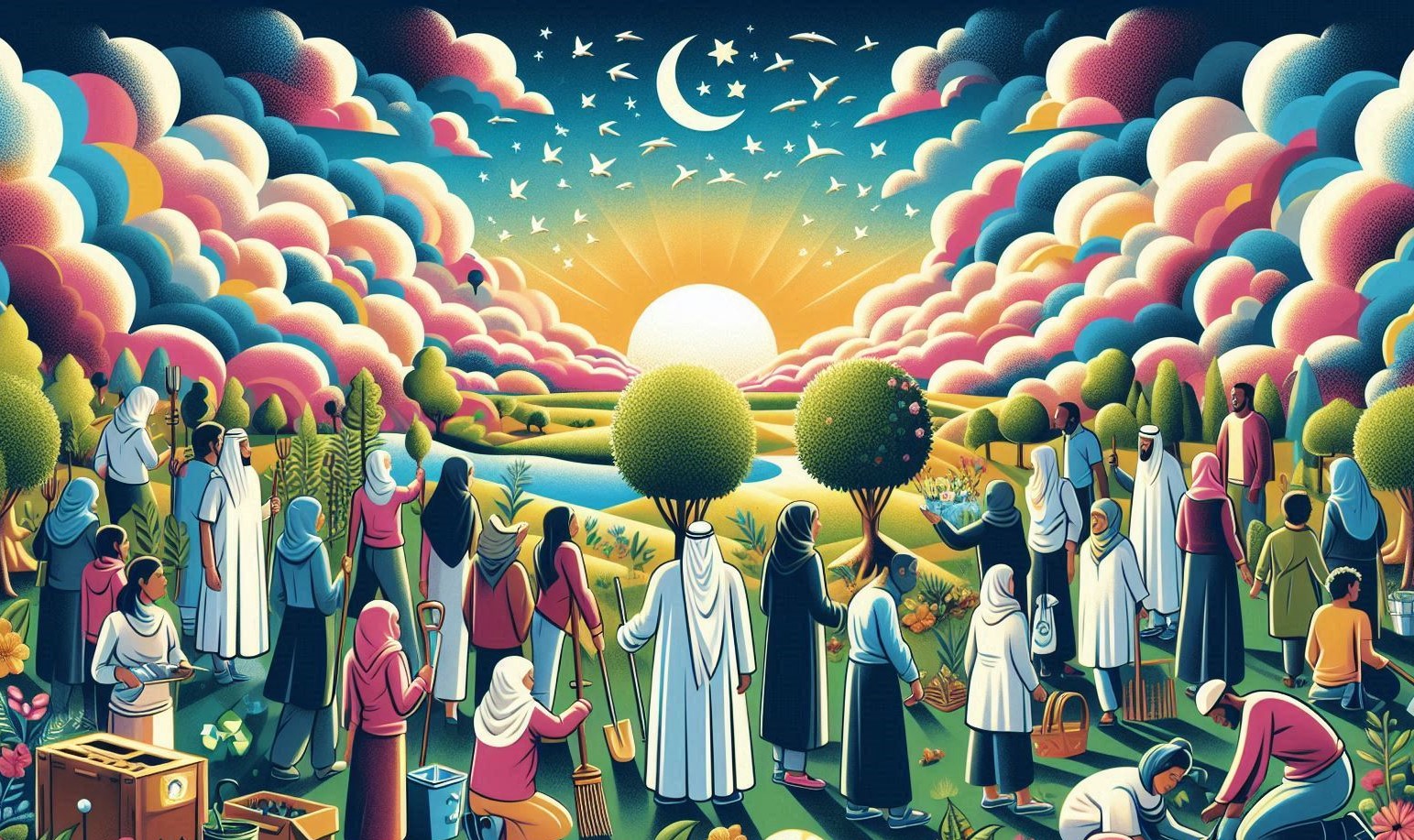
In an era defined by unprecedented ecological upheaval—from devastating wildfires and cataclysmic floods to accelerating species extinction—a profound psychological phenomenon has emerged: climate anxiety, or eco-anxiety. Defined by the American Psychological Association as a chronic fear of environmental doom, this condition reflects a deep-seated distress about the present and future state of our planetary home. While a global concern, its manifestation within Muslim communities carries unique theological and spiritual dimensions. For many Muslims, observing the degradation of creation is not merely a political or scientific issue; it is a profound spiritual and existential crisis that challenges their understanding of humanity’s place in the universe.
This guide posits that within the Islamic intellectual and spiritual tradition lies a powerful, resilience-fostering framework for navigating this anxiety: the paradigm of Khalifah (stewardship or vicegerency) and the correlated concept of Amanah (trust). Moving beyond a discourse of pure fear, Islam offers a balanced worldview that acknowledges the crisis, roots responsibility in divine covenant, and provides a pathway to meaningful, hope-infused action. By exploring the Islamic ecological ethic, we can transform paralyzing anxiety into purposeful stewardship, aligning ecological action with the ultimate objective of Islam: submission to, and harmony with, the Divine Will.
Understanding Climate Anxiety in a Modern Context
Climate anxiety is not a clinical diagnosis but a rational response to a tangible, large-scale threat. It encompasses feelings of grief, loss, helplessness, and frustration stemming from both direct experience of climate impacts and the overwhelming barrage of scientific reports forecasting worse to come ( Clayton, 2020). For individuals, it can lead to paralysis, depression, or obsessive guilt over personal carbon footprints. At a communal level, it can erode social cohesion and hope for the future.
In Muslim-majority nations—many of which are disproportionately vulnerable to climate change despite minimal historical emissions—this anxiety is compounded by immediate existential threats. From water scarcity in North Africa to sea-level rise in Bangladesh and the Nile Delta, climate change is not a future abstraction but a present danger to livelihoods, cultural heritage, and survival. For Muslims living as minorities in the industrialized West, the anxiety can be tinged with a complex dual identity: participating in high-consumption societies while feeling a theological dissonance with such lifestyles. The psychological burden is therefore multilayered, calling for a response that addresses both the emotional and the spiritual crisis.
The Foundations of Islamic Environmental Ethics: Tawhid, Ayat, and Mizan
To appreciate the Islamic response to ecological crisis, one must first understand its foundational cosmological principles.
- Tawhid (The Oneness of God): This is the cardinal principle of Islam. It asserts the absolute unity, sovereignty, and creativity of Allah. The universe is not a random collection of objects but a unified, purposeful creation emanating from a single Source. Consequently, nature is not a mere resource for human exploitation but a sacred tapestry reflecting its Creator. Destroying an ecosystem is not just an economic loss; it is an act of disrespect towards the signs (Ayat) of God and a violation of the inherent unity of creation.
- Ayat (Signs) in the Universe: The Quran repeatedly directs believers to contemplate the natural world as a medium through which God’s wisdom, power, and mercy are revealed. “Indeed, in the creation of the heavens and the earth and the alternation of the night and the day are ayat for those of understanding” (Quran 3:190). Every mountain, river, animal, and ecological process is an ayah (sign), just as the verses of the Quran are ayat. This imbues the environment with intrinsic sacred value. Climate change, in this view, obscures these signs, making it harder for humanity to perceive and connect with the Divine.
- Mizan (Balance and Equilibrium): The Quran establishes that creation is perfectly balanced (55:7-9). “And He has raised the heaven and set up the balance (Mizan)” (55:7). This concept of a cosmic, ecological, and moral equilibrium is central. Human actions that disrupt Earth’s delicate systems—such as emitting greenhouse gases at rates that overwhelm natural sinks—are a direct violation of this divinely ordained balance. The current climate crisis is, in Islamic terms, a manifestation of a profound imbalance, a rupture in the Mizan.
The Central Paradigm: Khalifah (Stewardship) and Amanah (Trust)
The locus of human responsibility is found in the twin concepts of Khalifah and Amanah.
- Khalifah: The Quran states, “And [remember] when your Lord said to the angels, ‘Indeed, I will make upon the earth a successive authority (Khalifah)’” (2:30). This verse positions humanity not as owners of the Earth, but as God’s vicegerents or stewards. This is a position of immense honor and equally immense responsibility. A steward manages property entrusted to them by its true owner, with the expectation of accountability. As Nasr (2003) eloquently argues, the modern environmental crisis stems from a fundamental forgetfulness of this role, where humans have assumed the position of conquerors and owners rather than humble custodians.
- Amanah: Closely linked is the “Trust” presented to the heavens, earth, and mountains, which they refused to bear, but which humanity accepted (33:72). Scholars interpret this Amanah as free will, moral agency, and the responsibility to uphold justice (Adl). The Earth and its ecosystems are part of this sacred trust. Therefore, pollution, unsustainable extraction, and the drive for endless economic growth that disregards ecological limits constitute a betrayal (khiyanah) of this trust. Climate anxiety, from this perspective, can be seen as the psychological symptom of a collective subconscious awareness of this betrayal.
This stewardship is not anthropocentric in a domineering sense, but theocentric. Humans are central in responsibility, not in privilege. Our role is to maintain the balance (Mizan), care for all creatures (Rahmah), and follow the divine guidance in our interaction with nature. We are accountable to God for how we treat His creation.
From Anxiety to Action: Islamic Principles for Ecological Resilience
The Khalifah framework provides a concrete pathway to transform anxiety into virtuous action, offering both psychological relief and practical direction.
- From Helplessness to Responsibility (Mas’uliyyah): Anxiety often stems from a sense of helplessness. Islam counteracts this by emphasizing individual and collective responsibility (Mas’uliyyah). The Prophet Muhammad (peace be upon him) said, “The world is green and beautiful, and God has appointed you His stewards over it” (Sahih Muslim). Every action, from conserving water (wudu) to planting trees (considered an act of ongoing charity, or Sadaqah Jariyah), is framed as a religious duty (Ibadah). This re-framing empowers the believer. One is not just reducing their carbon footprint out of political conviction but performing an act of worship that earns divine pleasure and fulfills the covenant of Khalifah.
- From Grief to Compassion (Rahmah): Witnessing ecological loss evokes deep grief. The Islamic principle of Rahmah (mercy, compassion) extends to all of creation (Rahmatan lil-‘Alamin). The Prophet showed kindness to animals, forbade needless waste of resources (Israf), and condemned ecological harm. He warned against polluting water sources and urged for the equitable sharing of resources. Channeling grief into compassionate action for afflicted communities and damaged ecosystems becomes a spiritually fulfilling response, aligning one’s heart with the divine attribute of Al-Rahman (The Most Merciful).
- From Consumption to Moderation (Zuhd and Qana’ah): A major driver of climate change is overconsumption, rooted in materialism and greed. Islam advocates for Zuhd (detachment from worldly excess) and Qana’ah (contentment with sufficiency). The Quran condemns those who “waste excessively” (6:141), labeling them as “brothers of the devils.” The Prophet’s life was a model of simplicity. Embracing a lifestyle of moderation is not a deprivation but a liberation from the anxiety-inducing cycle of consumerism and a direct method of reducing one’s ecological impact. It is a practical enactment of the prophetic warning that “enough for any of you is an amount that keeps his back upright” (a modest provision).
- From Short-termism to Intergenerational Justice (Adl): Climate anxiety is heavily future-oriented, concerned with the world we leave for our children. Islamic justice (Adl) is inherently intergenerational. The Quranic injunction to “not cause corruption on the earth after it has been set in order” (7:85) applies across time. Exploiting resources today to the point of depriving future generations is a profound injustice. The concept of Fiqh al-Awlawiyyat (jurisprudence of priorities) must now place long-term planetary health as a primary communal obligation (Fard Kifayah). This long view provides a moral compass that transcends political and economic cycles.
- Collective Action (Jama’ah) and Advocacy (Hisbah): Islam emphasizes the collective. The duty of stewardship is both individual and communal. The principle of Amr bil-Ma’ruf wa Nahy ‘an al-Munkar (enjoining good and forbidding wrong) translates directly into environmental advocacy (Hisbah). Speaking truth to power, demanding corporate and governmental accountability, and building sustainable community projects are modern expressions of this obligation. Acting within a community (Jama’ah) alleviates the isolation often felt in eco-anxiety and amplifies impact.
Spiritual Remedies: Tawakkul, Sabr, and Hope in Divine Mercy
Beyond action, Islam offers spiritual tools to manage the emotional weight of the crisis.
- Tawakkul (Trust in God): After taking all necessary means (Asbab), the believer places their trust in Allah. Tawakkul is not passive resignation but an active state of heart that relieves the burden of absolute control. One works diligently to plant trees, advocate for policy, and reduce waste, but ultimately recognizes that the full outcome is in God’s hands. This prevents burnout and despair, as the believer’s success is measured by sincere effort, not solely by the worldly outcome.
- Sabr (Patient Perseverance): Facing a long-term, complex crisis requires immense patience. Sabr is a repeatedly praised virtue in Islam—a “beautiful patience” (70:5) in the face of hardship. The environmental struggle is a marathon, not a sprint, and Sabr provides the spiritual endurance to continue despite setbacks, slow progress, and distressing news.
- Hope (Raja’) and Repentance (Tawbah): Islam strictly forbids despair of God’s mercy. “Do not despair of the mercy of Allah” (39:53). This hope is not naive optimism but is rooted in God’s promise of acceptance for sincere repentance and effort. The door of Tawbah is always open. On a collective scale, this means believing that human-caused damage can be met with divine facilitation for healing when coupled with genuine return to the principles of stewardship. Furthermore, Islamic eschatology, while detailing the signs of the end times, ultimately places the final decree in God’s knowledge. Our duty is to strive for justice and balance, not to predict or hasten an apocalyptic end.
Contemporary Applications and Challenges
Islamic financial principles (Islamic Finance) offer tools like the prohibition of Riba (usury), which critiques the interest-based growth model driving unsustainable consumption, and the emphasis on risk-sharing and asset-backed financing that could support a circular economy. The revival of Hima (protected zones) and Harim (inviolable zones around water sources) concepts provides traditional models for ecosystem conservation. Grassroots movements like the Islamic Declaration on Global Climate Change (2015) and the work of organizations like the Islamic Foundation for Ecology and Environmental Sciences (IFEES) are applying these principles.
However, significant challenges remain. There is a gap between theological ideals and practice in many Muslim societies, often influenced by political instability, poverty, and the import of Western consumerist models. Religious leaders (Ulama) need deeper ecological literacy to integrate these issues into sermons and rulings (Fatwas). Furthermore, Islamic scholarship must continue developing a rigorous Fiqh al-Bi’ah (Islamic environmental jurisprudence) to address novel issues like carbon trading, biodiversity offsets, and climate migration.
Conclusion
Climate anxiety is a rational, human response to a civilization-scale crisis. For Muslims, however, it need not be a disabling pathology. The Islamic paradigm of Khalifah recontextualizes the crisis from a purely secular, often dystopian narrative, into a profound moment of moral and spiritual reckoning. It replaces the anxiety of an owner watching their property burn with the determined resolve of a steward tasked by the true Owner to protect and repair.
By grounding action in Tawhid, responsibility in Amanah, and lifestyle in Mizan and Qana’ah, Islam provides a comprehensive blueprint for ecological living. It couples this with the spiritual resilience of Tawakkul, Sabr, and Raja’. In doing so, it transforms eco-anxiety from a state of paralyzing fear into a catalyzing force for worship, community building, and justice. The task of the Muslim in the Anthropocene is clear: to be a mindful, active, and hopeful Khalifah, working with others to restore the balance, uphold the trust, and read once again the obscured Ayat in a wounded but still wondrous world. The path forward is not one of despair, but of returning to a covenant older than modernity itself—a covenant of sacred stewardship.
SOURCES
Aboul-Enein, Y. (2019). Towards a Fiqh for the Planet: Islamic Environmental Law and Muslim Ecological Praxis. Islamic Research Institute.
Clayton, S. (2020). Climate anxiety: Psychological responses to climate change. Journal of Anxiety Disorders, 74, 102263.
Foltz, R. C., Denny, F. M., & Baharuddin, A. (Eds.). (2003). Islam and Ecology: A Bestowed Trust. Harvard University Press.
Gade, A. M. (2019). Muslim Environmentalisms: Religious and Social Foundations. Columbia University Press.
Islamic Foundation for Ecology and Environmental Sciences (IFEES). (2015). Islamic Declaration on Global Climate Change.
Khalid, F. M. (2010). Islam and the environment. In Routledge Handbook of Religion and Ecology (pp. 111-124). Routledge.
Nasr, S. H. (2003). The Encounter of Man and Nature: The Spiritual Crisis of Modern Man. Kazi Publications.
Ozdemir, I. (2003). Toward an understanding of environmental ethics from a Qur’anic perspective. In Islam and Ecology (pp. 3-37). Harvard University Press.
World Health Organization. (2022). Mental health and climate change: policy brief. WHO.
HISTORY
Current Version
Jan 2, 2026
Written By:
SUMMIYAH MAHMOOD